Top E-Product

Umrah and Hajj


Great Stuff on Hajj And Umrah

Free information about hajj and umrah and some information about makkah  CLICK HERE.

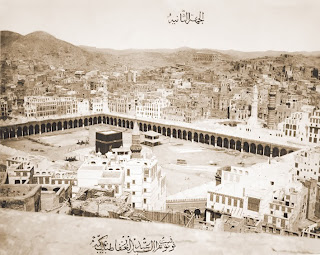
Pictures of Mecca Before 100 Years

Pictures of Mecca Before 100 Years


Pictures of Mecca

New Pictures of Mecca


Old  Pictures of Mecca

Mecca ( From Wikipedia, the free encyclopedia )


Mecca (English pronunciation: /ˈmɛkə/Arabicمكة‎, Makkahpronounced [ˈmækːɐ]) is a city in the Hijaz and the capital of Makkah province in Saudi Arabia. The city is located 73 km (45 mi) inland from Jeddah in a narrow valley at a height of 277 m (909 ft) above sea level. Its resident population in 2008 was 1.7 million, although visitors more than double this number every year during Dhu al-Hijjah.
As the birthplace of prophet Muhammad and a site of the composition of the Quran,Mecca is regarded as the holiest city in Islam and a pilgrimage to it known as the Hajj isobligatory upon all able Muslims. The Hijaz was long ruled by Muhammad's descendants, the sharifs, either as independent rulers or as vassals to larger empires. It was absorbed into Saudi Arabia in 1925. In its modern period, Mecca has seen tremendous expansion in size and infrastructure. Because of this Mecca has lost many thousand years old buildings and archaeological sites. Today, more than 13 million Muslims visit Mecca annually, including several million during the few days of the Hajj. As a result, Mecca has become one of the most cosmopolitan and diverse cities in the Muslim world, although non-Muslims remain formally prohibited from entering the city.

For More Details : http://en.wikipedia.org/wiki/Mecca
------------------------------------------------------------------

Cheapest makkah hotels list

You can read about Cheapest makkah hotels list 


at this site  : www.allrez.com


--------------------------------------------------------------

Cheapest Umrah Deals Packages 2012 UK

If you are looking for an Umrah Package 2012 and a   good umrah deals


More information  and umrah packages from uk more

Hajj

You can get free information about Hajj from:
http://en.wikipedia.org/wiki/Hajj

Makkah Project


Here's a list some of the major projects in Makkah,

Jabal AlKabaa
Area: 42,000 sq m
9 propused hotel towers (20-25 floors)
1 under uonstruction hotel tower (25 floors)

Jabal Omar
Area: 230,000 sq m
2 hotel towers (50 floors)
2 residential towers (48 floors)
7 residential towers (30 floors)
4 office towers (15 floors)

King AbdulAziz Road
5 km long
60 m wide
Land reclimation along both sides of the road.
An elevated mosque

Jabal Khidimah
Land Development project
Area: 137,000 sq m (phase I)
600,000 (phase II)

SahmiyahProject
Land Development Project

Ajyad Hospital and Hotel Tower
24 floors hotel + 7 floors hospital

Al Shurfah Project
Residential tower (22 floors)

Burj Al-ewar
21 floors

Multlaq Tower
26 floors

Abraj Al-Bait
6 residential towers (32-47 floors)
1 hotel tower (76 floors)

Saudia Tower
32 floors

Le Meridian Towers
Area: 165,000 sq m
8 hotel towers (22 floors each)

Emar Makkah Towers
three 22 sotreys residential towers
Location: East of Makkah (Kindy District)
Developer: Rikaz
Status: Under-construction

Jabal Alqala'a
Area: 29,585 sq m
Land reclamation for 5 propused hotel towers

Bait Makkah 12 Tower
24 floors
Location: Prince Majed Road (4200 m East of the holy Mosque)
Status: Under Construction

from http://www.skyscrapercity.com/showthread.php?t=189499

Makka old yesterday and today


Makkah (since 100 years Old )


Makkah Today

Make Money Typing Online ADS

Make money typing ads online. Online jobs and work at home opportunities for everyone. Information on home based businesses and jobs from home
start earning $100s weekly typing ads for companies at home. Also get access to over dozen other money making opportunities
--------------------------------------------------------------------

YOU HAVE AN OPEN INVITATION

DEARS,

NOW YOU CAN GET A FREE TRIP IN MAKKAH WITH MY BLOG , YOU CAN WATCH A REAR PHOTOS , TONS OF INFORMATION ABOUT MAKKAH AND A NEW PROJECTS....

ALSO YOU CAN TAKE A FREE TOUR WITH MANASEK ALHAJJ

BUT YOU CAN RECIVE YOUR GIFT DURING YOUR VISIT LIKE A FREE DOMAIN, FREE HOSTING , JOIN IN SITE TO BLOG AND PAID MONEY AND OTERS

Ka'ba, Bait-ul Allah

House Of Allah On Earth

The Kaaba: It's Size and History!

The small, cubed building known as the Kaaba may not rival skyscrapers in height or mansions in width, but its impact on history and human beings is unmatched.

The Kaaba is the building towards which Muslims face five times a day, everyday, in prayer. This has been the case since the time of Prophet Muhammad over 1400 years ago.

The Size of the Kaaba:

The current height of the Kaaba is 39 feet, 6 inches and total size comes to 627 square feet.

The inside room of the Kaaba is 42.64x29.52 feet. The Kaaba's walls are one 3.28 feet wide. The floor inside is 7.22 feet higher than the place where people perform Tawaf.

The ceiling and roof are two levels made out of wood. They were reconstructed with teak which is capped with stainless steel.

The walls are all made of stone. The stones inside are unpolished, while the ones outside are polished.

This small building has been constructed and reconstructed by Prophets Adam, Ibrahim, Ismail and Muhammad (peace be upon them). No other building has had this honor.

Facts about the Kaaba that many are unaware of.

The other names of the Kaaba

Literally, Kaaba in Arabic means a high place with respect and prestige. The word Kaaba may also be derivative of a word meaning a cube.

Some of these other names include:

Bait ul Ateeq-which means, according to one meaning, the earliest and ancient. According to the second meaning, it means independent and liberating. Both meanings could be taken


Bayt ul Haram-the honorable house


The Kaaba has been reconstructed up to 12 times

Scholars and historians say that the Kaaba has been reconstructed between five to twelve times.

The very first construction of the Kaaba was done by Prophet Adam. Allah says in the Quran that this was the first house that was built for humanity to worship Allah.

After this, Prophet Ibrahim and Ismail rebuilt the Kaaba. The measurements of the Kaaba's Ibrahimic foundation are as follows:

the eastern wall was 48 feet and 6 inches

the Hateem side wall was 33 feet

the side between the black stone and the Yemeni corner was 30 feet

the Western side was 46.5 feet

Following this, there were several constructions before the Prophet Muhammad's time.

Reconstruction of Kaaba by Quraish

Prophet Muhammad participated in one of its reconstructions before he became a Prophet.

After a flash flood, the Kaaba was damaged and its walls cracked. It needed rebuilding.

This responsibility was divided among the Quraish's four tribes. Prophet Muhammad helped with this reconstruction.

Once the walls were erected, it was time to place the Black Stone, (the Hajar ul Aswad) on the eastern wall of the Kaaba.

Arguments erupted about who would have the honor of putting the Black Stone in its place. A fight was about to break out over the issue, when Abu Umayyah, Makkah's oldest man, proposed that the first man to enter the gate of the mosque the following morning would decide the matter. That man was the Prophet. The Makkans were ecstatic. "This is the trustworthy one (Al-Ameen)," they shouted in a chorus. "This is Muhammad".

He came to them and they asked him to decide on the matter. He agreed.

Prophet Muhammad proposed a solution that all agreed to-putting the Black Stone on a cloak, the elders of each of the clans held on to one edge of the cloak and carried the stone to its place. The Prophet then picked up the stone and placed it on the wall of the Kaaba.

Since the tribe of Quraish did not have sufficient funds, this reconstruction did not include the entire foundation of the Kaaba as built by Prophet Ibrahim. This is the first time the Kaaba acquired the cubical shape it has now unlike the rectangle shape which it had earlier. The portion of the Kaaba left out is called Hateem now.

Construction After the Prophet's Time-Abdullah ibn az-Zubayr

The Syrian army destroyed the Kaaba in Muharram 64 (Hijri date) and before the next Hajj Abdullah ibn az-Zubayr, may Allah be pleased with him, reconstructed the Kaaba from the ground up.

Ibn az-Zubayr wanted to make the Kaaba how the Prophet Muhammad wanted it, on the foundation of the Prophet Ibrahim.

Ibn az-Zubayr said, "I heard Aisha (may Allah be pleased with her) say, 'The Prophet said: "If your people had not quite recently abandoned the Ignorance (Unbelief), and if I had sufficient provisions to rebuild it [the Kaaba], I would have added five cubits to it from the Hijr. Also, I would make two doors; one for people to enter therein and the other to exit." (Bukhari). Ibn az-Zubayr said, "Today, I can afford to do it and I do not fear the people. 

Ibn az-Zubayr built the Kaaba on Prophet Ibrahim's foundation. He put the roof on three pillars with the wood of Aoud (a perfumed wood with aroma which is traditionally burned to get a good smell out of it in Arabia).

In his construction he put two doors, one facing the east the other facing the west, as the Prophet wanted but did not do in his lifetime.

He rebuilt the Kaaba on the Prophet Ibrahim's foundation, which meant that the Hateem area was included. The Hateem is the area adjacent to the Kaaba enclosed by a low semi-circular wall.

Abdullah ibn az-Zubayr also made the following additions and modifications:

put a small window close to the roof of the Kaaba to allow for light.

moved the door of the Kaaba to ground level and added a second door to the Kaaba.

added nine cubits to the height of the Kaaba, making it twenty cubits high. 

its walls were two cubits wide. 

reduced the pillars inside the House to three instead of six as were earlier built by Quraish. 

For reconstruction, ibn az-Zubayr put up four pillars around Kaaba and hung cloth over them until the building was completed. People began to do Tawaf around these pillars at all times, so Tawaf of the Kaaba was never abandoned, even during reconstruction.

During Abdul Malik bin Marwan's time

In 74 Hijri (or 693 according to the Gregorian calendar), Al-Hajjaj bin Yusuf al-Thaqafi, the known tyrant of that time, with the approval of Umayyad Khalifa Abdul Malik bin Marwan, demolished what Ibn az-Zubayr had added to it from the older foundation of Prophet Ibrahim, restore its old structure as the Quraish had it.

Some of the changes he made were the following:

he rebuilt it in the smaller shape which is found today

took out the Hateem

walled up the western door (whose signs are still visible today) and left the rest as it was

pulled down the wall in the Hateem area.

removed the wooden ladder Ibn az-Zubayr had put inside the Kaaba.

reduced the door's height by five cubits

When Abdul Malik bin Marwan came for Umra and heard the Hadith that it was wish of Prophet for the Kaaba to be constructed the way Abdullah ibn az-Zubayr had built it, he regretted his actions.

Imam Malik's advice to the Khalifa Harun al Rasheed

Abbasi Khalifa Harun al Rasheed wanted to rebuild the Kaaba the way the Prophet Muhammad wanted and the way Abdullah ibn az-Zubayr built it.

But when he consulted Imam Malik, the Imam asked the Khalifa to change his mind because constant demolition and rebuilding is not respectful and would become a toy in the hands of kings. Each one would want to demolish and rebuild the Kaaba.

Based on this advice, Harun al Rasheed did not reconstruct the Kaaba. The structure remained in the same construction for 966 years, with minor repairs here and there.

Reconstruction during Sultan Murad Khan's time

In the year 1039 Hijri, because of heavy rain, flood and hail, two of the Kaaba's walls fell down.

The flood during which this occurred took place on the 19th of Shabaan 1039 Hijri which continued constantly, so the water in the Kaaba became almost close to half of its walls, about 10 feet from the ground level.

On Thursday the 20th of Shabaan 1039 Hijri, the eastern and western walls fell down.

When flood receded on Friday the 21st of Shabaan, the cleanup started.

Again, a curtain, the way Abdullah ibn az-Zubayr established on 4 pillars, was put up, and the reconstruction started on the 26th of Ramadan. The rest of the walls except for the one near the Black Stone, were demolished.

By the 2nd of Dhul Hijjah 1040 the construction was taking place under the guidance of Sultan Murad Khan, the Ottoman Khalifa. From the point of the Black stone and below, the current construction is the same as that done by Abdullah ibn az-Zubayr.

The construction which was done under the auspices of Murad Khan was exactly the one done at the time of Abdul Malik ibn Marwan which is the way the Quraysh had built it before Prophethood.

On Rajab 28 1377, One historian counted the total stones of the Kaaba and they were 1,614. These stones are of different shapes. But the stones which are inside the outer wall which is visible are not counted in there.

Reconstruction of the Kaaba In 1996

A major reconstruction of the Kaaba took place between May 1996 and October 1996.

This was after a period of about 400 years (since Sultan Murad Khan's time).

During this reconstruction the only original thing left from the Kaaba are the stones. All other material has been replaced including the ceiling and the roof and its wood.

What is inside the Kaaba?

The president of the Islamic Society of North America (ISNA) had the opportunity to go inside the Kaaba in 1998. He describes the following features:

there are two pillars inside (others report 3 pillars)

there is a table on the side to put items like perfume

there are two lantern-type lamps hanging from the ceiling

the space can accommodate about 50 people

there are no electric lights inside

the walls and floors are of marble

there are no windows inside

there is only one door

the upper inside walls of the Kaaba were covered with some kind of curtain with the Kalima written on it

from: http://www.geocities.com/TheTropics/Coast/9150/Kaaba.html

KAABA'S DOOR


The door of the Kaaba on the ground ... eventually rise by about 2.5 and 3.06 m high section and presented, and section 1.68 meters exists today a gift of King Khalid Bin Abdul Aziz God bless his soul has been made from gold, with the amount of gold used for the sections about 280 mm 99.99 kg at a total cost of 13 million and 420 thousand riyals, except the quantity of gold which have been made secure by the Saudi Arabian Monetary Agency Highlighted in 22 AH 1399 e

Qibla Locator


With Qibla Locator you can find the direction of the qibla from anywhere in the world.

just click the link

www.qiblalocator.com


Jabal Omar project


 Site area 230,000 m 2 
The cost of real estate 4,700 million 
Infrastructure cost of 1,300 million rials 
Developed land area 126,000 m 2 
The following is a summary of the main objectives of the project: 
1 - Ensuring adequate housing for the number of 34,500 people, hotels and residential units. 
2 - Development of a residential area and commercial model in accordance with the standards of modern planning, taking into account the interdependence of topography and the physical fabric of the site. 
3 - the provision of new streets and avenues and public squares and pedestrian tunnels with ladders, conveyors and moving into the project provides easy movement of pilgrims and Umrah performers to and from campus. 
4 - To provide adequate positions for about 12,000 cars. 
5 - Development of infrastructure for the entire project area, with the work of tunnels for extensions of service lines inside "water, sanitation, electricity and a phone." 
6 - Establishment of the chapel is covered with a capacity of about 100,000 worshipers in addition to the Chapels of existing buildings and covered a total of 98 prayer total capacity of about 87,000 worshipers, with toilets and wash their own premises, in addition to open mosques to accommodate about 15,000 worshipers. 
 Escalators to "public use": 
- The number of escalators to "public use" 172 Peace 
- The number of elevators "for those with special needs" 25 elevator 
- The number of elevators in the entire 560 elevator project 
- Length of mobile belts in tunnels and pedestrian walkways 140 linear meters 
The establishment of a tunnel for cars by Khalil Ibrahim cladding along the northern and eastern parts of Jabal Omar project to separate the region in both directions of traffic on the movement of pedestrians, so as to allocate the existing road surface for pedestrians and be an extension of the courtyards of the Haram al-Sharif, a length of 900 meters, and its width is 40 meters, and consists of three tracks in each head of direction, and tracks services in each direction. 

Tunnel key services by Khalil Ibrahim, a tunnel parallel to the car in order to extend all service lines, "the main and subsidiary" within the region, with the potential to accommodate any future additions to the services of electricity / water / sewage / telephone / gas .... etc., offer up to 12 meters, and at altitudes of up to 4 meters, the tunnel will be the completion of extensions to the core infrastructure in the Holy City, and will benefit from the company's "first tranche / second tranche / third tranche" and other projects, and can be rented to beneficiaries of an investment location, "rental benefit" The goal of the company to reach all regions of Mecca.To provide sites for public services, "the police, civil defense and clinics, and public toilets."


                                                          project plan & perspictive

        An aerial view of the site

Development project Shamia


 Location and Area: 

Shamia located in a series of development projects by the government to develop the areas surrounding Mecca's Holy Shrine 
And re-configured to be more appropriate to the needs of the region and visitors, 
The project covers an area of one million five hundred thousand square meters, almost 
Ranging from parties to the Haram al-Sharif after the second ring road north and east, the Grand Mosque Street 
The road to the west of Jabal Kaaba 
The outline includes Shamia and Grol and Qarara and Anaka The area intended for development of three million square meters 
Distributed to a number of different activities including: 

Hotels and hotel accommodation and shopping malls, markets and public services in addition to permanent housing 
For the people of the region and related services 

The absorptive capacity of the project about two hundred and fifty thousand people in addition to 
The capacity of the worshipers of about four hundred thousand worshipers. 


 Services and facilities: 
Stages of the scheme consists of Shamia the main axes of the infantry and the hotels listed 
It is composed of three levels, separated by a broad street 
And lined by a string of hotels in central linear phased 
Allowed to Balitalal on the Haram al-Sharif 
Characterized this group of hotels near the campus grounds and ruins it 
The project consists of residential castle, a group of buildings devoted highest mountain of the Indian hotel accommodation 
Permanent housing and has developed a physical style inspired 

North Gate of the project, a major milestone in the project consists of a special tower mediating a large yard 
Surrounded by a group of medium-rise buildings that have been allocated to the activities of the commercial and shopping 
Cut off the bottom of the plant gate and consists of five floors containing 
Bus station and car garages, where the garages of some cars (10500) car and a bus 

  Objectives of the project 
- Development of physical environment to suit the place of the Holy Mosque in Mecca Sharif. 
- Integration with the structural plan for the development of the central region of Mecca. 
- The restructuring of the road network in order to: 
Expansion of the Haram al-Sharif yards to accommodate the largest number of worshipers. 
Actor placement for the entire study area. 
- Ensuring public safety for residents and visitors by: 
Separation of pedestrian traffic on the movement of vehicles. 
Construction Law. 
Safe and rapid exit of the crowds of pilgrims from the northern side of campus. 
- Alleviate the pressure of urban development in the area on the borders of the Haram al-Sharif directly. 
- Linking the interior of the benefits of Shamia developers, and the distribution of value of real estate development process. 

Impact on the development of the Shamia squares-Haram Al-Sharif 
- Expansion of the Haram al-Sharif yards from the north and north-west at a depth of 120 meters, 
Taking into account the limits of land and buildings, and the network of roads, the natural terrain of the site to avoid any sharp rapids. 

- Interior design arenas in Shamia to be integrated into the courtyards of the Haram al-Sharif to take into account the point of the direction of Qibla 
And secure optical communication Noble for the possibility of prayer. 


Services and land uses 

Organization of land uses that serve visitors in the vicinity of the Haram al-Sharif. 
To maintain the proportions of people living in different parts of the study area. 

Allocation of 7% of the total area of public services. 

Schools - a fire station - the police station - Clinic - public facilities. 

Determining the area to cut the ground floor of the development of 
900 square meters, as the requirements of secure garage. 
Stages of development: 

Studies have been prepared for the start of stages of development, which takes a 

10 years 
At a total cost of 40 billion rials 
Comes in the form of stages of beginning to develop infrastructure and provide the site with full services 
Which make it up to date in the world ..!! 
It is expected that the duration of the first phase which will begin soon about 3 years 

6 billion riyals compensation 

Were observed more than 6 thousand million in compensation for the project will be tasked with Bin Laden, Saudi Arabia, the implementation of the expansion 
Will be eliminated, and nearly 1000 real estate for the benefit of this major project 
from: www.abunawaf.com

Ajyad new hospital


 Project location: 

Mecca for the South Central Area 
For the campus of South-east of Mecca's Holy Mosque in Mecca Sharif 

Borders: 
North Ajyad through the dam and the small-market tunnel 
East and the positions of the Ministry of Holy Affairs 
South Ring Road in the first tunnel 
West through the Ajyad General 

  Objectives of the project: 

The project aims to establish a health-based residential and commercial hotel in the east of the site reserved for him at the hospital and the current development of the current site Ktusap of the Haram al-Sharif on the grounds that the development plan include the following: 
1. The establishment of an integrated hospital and medical center equipped with the latest advanced technologies. 
2nd To provide the finest services and emergency aid. 
3rd Securing diagnostic and therapeutic services. 
4th Ensure better communication between the project and the grounds of the campus. 
5th Upgrading the infrastructure of the surrounding area. 
6th Contribute to the expansion of fields around the Grand Mosque to pray and to provide appropriate services to them. 
7th Establishment of a residential hotel to provide superior hotel services, decent visitors to the White-man's land and to ensure the best possible overview of the old house. 
8th Submit a draft high architectural and integrated with the surrounding residential environment through the efforts made by the body to the upgrading of the central region. 


 Project description: 

Hospital integrated with a number of the upper floors of the building of an investment project to stop after a number of years of campus-Makki al-Sharif. With a total area of 1110.000 m 2 (apart from the mezzanine and parking services and the roles and the role of prayer) is of about 20,000 m 2 for the establishment of a hospital Bttaghizadtha by the Ministry of Health specifications and requirements of the rest of the area would be for investment. 

Site total area: 0.52 hectares. 
Absorptive capacity of the project: 4495 people. 
from: http://www.mpd.gov.sa

PART TIME JOB FOR YOU

Hello ...... ,

I want to tell you about a great site I found. They pay me to read e-mail,
visit web sites and much more.

It's free to join and easy to sign up! CLICK THIS

LINK TO VISIT:

http://www.silvanamails.net/pages/index.php?refid=msamara

Manasek Alhajj

قال تعالى: الحج أشهر معلومات فمن فرض فيهن الحج فلا رفث ولا فسوق ولاجدال فى الحج

Due to the fact that Hajj (Muslim Pilgrimage to Mecca, Saudi) is about to start on the overnight stay in Mina on the 8th of  Al Hija ).the day of Tarwia

Hajj was very tiring, yet very rewarding       الثواب قدر المشقة


"AL HAJJ IS ARAFA"
In the early mornning on the 9th Al Hija all of the haj go to Araft (the day of Alhaj Alakbar),and stay in Arafat and pray alzoher and elasr(gaman and kasran), directly after azan almaghreb all of the Hajj go to mozdalefa.


Mozdalefa locate betwen Arafat and Mina all of Haj stay in it and pray Almaghreb and Elesha 
(gaman and kasran) and sleep in it.

In the early mornning on the 10th Al Hija all of the haj go to Mina and go to jamarat bridge to throw jamret al aqba al kobra then you can shaving, make twaf alefada and  butchring Alhady.


The Tashrique Days
All Hajj stay in Mina at 11,12th and may be 13th Alhija to finish the Manasek alhaj.

Alhajj

Makkah's REAR PHOTOS

Old Photos for Torrents inside Haram Makkah

ALSA'AY BETTWEN ALSAFA AND ALMARWA BY SWIMMING

REAR PHOTOS


MEN SWIMMING ARROUND KAABA ( ALMATAF)

Makkah's photos


old photos to Alharam

makkah


my lovely country i want to make haj and umra again, i love it to much but i cann't living again in it,a holy land i will coming again

i love you